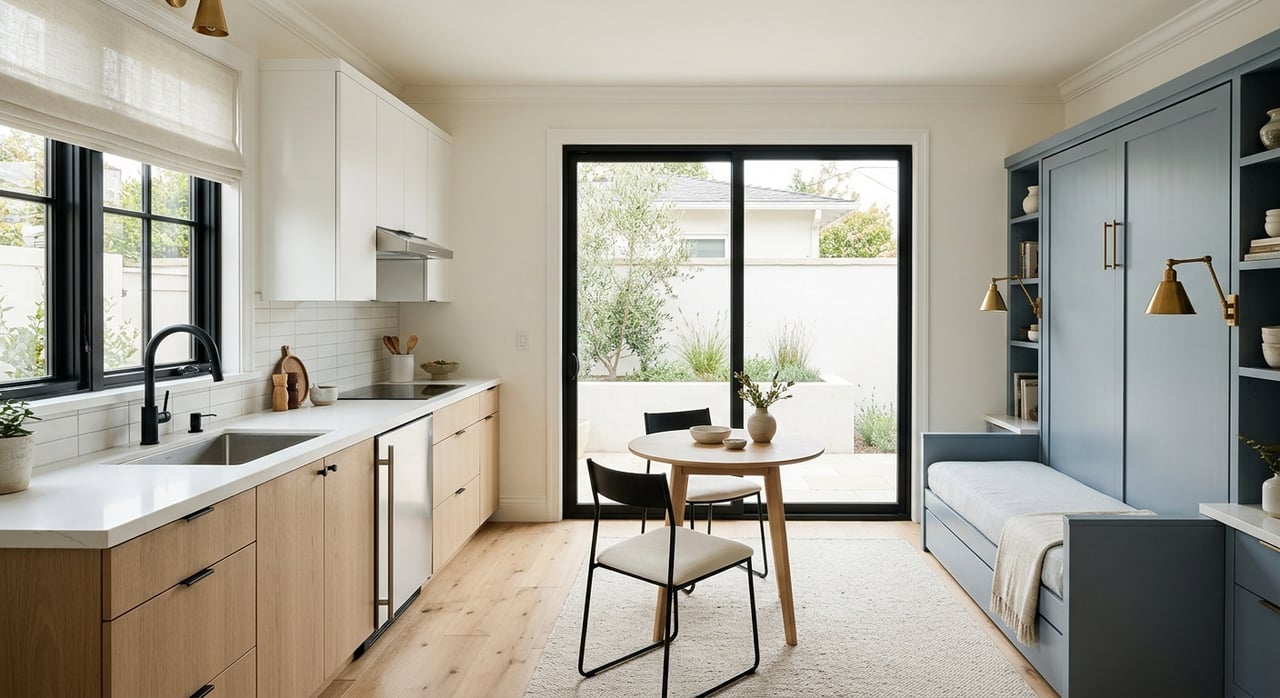
Anaheim ADU Rental Potential by Neighborhood
May 21, 2026
May 21, 2026
Thinking about adding an ADU in Anaheim? You are not alone. For many homeowners and small investors, an ADU can create long-term rental income, add flexibility to a property, and make better use of an existing lot. The key is knowing where the numbers make sense, which neighborhoods support stronger rents, and how Anaheim’s rules shape your options. Let’s dive in.
Anaheim is relatively ADU-friendly compared with many cities. In single-family residential areas, the city allows one ADU converted from existing space, one new-construction ADU, and one JADU, with a total cap of four dwelling units on the lot.
On existing multifamily lots, Anaheim allows at least one ADU and up to 25% of the existing units. The city also allows up to eight detached ADUs on a lot with an existing multifamily dwelling, subject to the existing-unit cap.
That matters because it gives you more than one path. You might convert a garage, build a detached unit, or look for a property that already has a legal conversion and less construction risk.
If you are evaluating rental potential, the best starting point is not rent. It is the local rule set. In Anaheim, zoning, parking, occupancy, and permit timing can all affect your budget and timeline.
Anaheim’s standards are especially favorable for conversions. Legally established conversions of garages, carports, or other accessory structures can avoid some setback, height, and building-separation rules.
There is another practical benefit. If you convert a garage or covered parking area, the city does not require replacement parking for that converted space.
For many owners, that can improve the pro forma. A lower-cost conversion often has a better chance of producing stronger returns than a detached build with a much higher all-in basis.
Detached ADUs must meet four-foot side and rear setbacks. They also have a maximum height of 18 feet plus roof pitch, or the height of the main dwelling, whichever is greater.
Detached units can still be attractive when you want a more independent rental layout. In some Anaheim submarkets, stronger rent levels may justify the higher construction cost, especially if the site is straightforward and utility work is manageable.
Parking can make or break an ADU plan, but Anaheim’s code offers several exceptions. The city requires zero parking spaces for a studio ADU and one space for a one-bedroom-or-larger ADU.
There are also exemptions in several common situations, including when the property is within a half-mile of transit, when the ADU is part of the primary residence or an existing accessory structure, or when a garage or carport is demolished or converted. JADUs require no parking.
A JADU can work in the right situation, but it is usually less flexible than a standard ADU for pure rental strategy. Anaheim requires owner occupancy when a JADU shares sanitation facilities with the primary residence, and the unit that is not owner-occupied must be rented for at least 30 consecutive days.
State guidance also says JADUs cannot be used as short-term rentals and, if rented, must be rented for longer than 30 days. If your goal is simple long-term rental income, a standard ADU is often the cleaner option.
Anaheim says most ADUs and JADUs go through the standard building review process. The city also offers a pre-approved plan catalog, which may help reduce design time for some projects.
The process is structured in a way that can help with planning. Staff must determine application completeness within 15 business days and approve or deny a complete application within 60 days.
That timeline matters because delay has a cost. The longer a project sits in review, the more your financing carry and holding costs can affect returns.
Rental potential is not the same across Anaheim. Some neighborhoods show stronger rent levels, while others may still work well if your build cost stays under control.
For consistency, this article uses RentCafe neighborhood rent data as the main rent benchmark. That is important because citywide rent estimates vary depending on the source and unit mix.
RentCafe reports average rents of about $3,018 in Platinum Triangle, $2,791 in Anaheim Hills, $2,566 in The Colony, and $2,487 in Anaheim Resort. These higher-rent areas can support stronger ADU income, especially for well-finished detached units or efficient one-bedroom layouts.
The tradeoff is usually basis. Home values also vary across Anaheim, with Zillow showing neighborhood home values around $748,176 in Platinum Triangle, $784,275 in Anaheim Resort, $867,056 in The Colony, and $1,262,520 in Anaheim Hills.
If you are buying with the goal of adding an ADU later, those price differences matter. A stronger rent market does not automatically mean a better return if your land and construction costs are much higher.
RentCafe reports neighborhood averages of about $2,328 in Northeast Anaheim, $2,316 in Northwest Anaheim, and $2,314 in West Anaheim. These areas may not post the top rent numbers in the city, but they can still make sense for ADU projects.
This is where cost control becomes critical. A garage conversion or existing-space conversion may pencil better than a detached build if rent lands closer to the middle of Anaheim’s range.
Current listing examples help show what tenants are paying for smaller units in Anaheim. Zillow currently shows a 400-square-foot detached studio ADU at $2,499 per month, a newer one-bedroom ADU at $2,350 per month, a two-bedroom back unit at $3,300 per month, and a newer three-bedroom ADU at $3,500 per month.
Those examples suggest an important point. Well-finished small units can rent above some citywide apartment averages, especially when the layout, privacy, and condition are strong.
The best ADU decisions usually come down to a simple question: how does likely rent compare with your total basis? In Anaheim, the biggest sensitivity is often not just monthly income. It is the full project cost after permits, utility work, site conditions, and construction.
A 2026 HomeGuide cost guide estimates ADUs at roughly $100 to $300 per square foot overall. It breaks out detached ADUs at about $150 to $250 per square foot, garage conversions at about $50 to $200 per square foot, and above-garage ADUs at about $200 to $500 or more per square foot.
For a 600-square-foot detached ADU, that guide shows about $90,000 to $150,000 before higher-end finishes or local complexity push the number higher. Labor can represent 40% to 60% of project cost, and soft costs like permits, grading, surveys, and foundation work also matter.
California’s fee rules can improve the economics for smaller ADUs. According to the state housing handbook, ADUs of 750 square feet or less are exempt from local impact fees, while larger ADUs are charged proportionately.
JADUs of 500 square feet or less are also exempt from local impact fees. School impact fees are not charged on ADUs and JADUs under 500 square feet.
That does not make a small ADU automatically better, but it does mean size can affect more than rent. It can also affect your upfront cost structure.
Here are three illustrative examples based on Anaheim rent figures and a 25% reserve for vacancy and operating costs:
These are not guarantees. They are a reminder that the lower-cost path often wins on return, while the higher-rent detached path may still work if you value privacy, resale appeal, or a larger future tenant pool.
Rental income is only part of the story. Some buyers also see an ADU as a way to support future flexibility, multigenerational living, or offset ownership costs.
A 2024 UCI and Real Estate Economics study of Los Angeles found that ADU presence raised assessed value and selling price by 7% to 9%. Anaheim is a different market, so that should be treated as a California comparison point, not a direct prediction for any Anaheim property.
Still, the broader takeaway is useful. A legal, well-built ADU may add value beyond the rent check alone.
For most Anaheim owners and buyers, there are three practical paths to compare.
This path often works best when you already have usable garage or accessory space. It may offer a lower budget, fewer site challenges, and stronger returns if your neighborhood supports healthy one-bedroom demand.
This path may fit better if your lot has room, the layout supports privacy, and neighborhood rents are closer to the upper end of Anaheim’s range. It usually requires more capital, so you want to be especially careful about total basis.
In some cases, the smartest move is to buy a property with an existing legal conversion or clear ADU path. That can remove much of the entitlement and construction risk and give you a clearer income picture from day one.
If you are comparing properties or deciding whether to build, keep your process simple:
That kind of disciplined approach fits Anaheim well. The city’s rules and permit structure make ADU planning more predictable than it used to be, but neighborhood rent differences still play a big role in the final outcome.
If you want help comparing Anaheim neighborhoods, reviewing a property’s ADU potential, or thinking through the numbers before you buy or build, reach out to Tony Hong. His finance-driven, relationship-first approach can help you make a clearer real estate decision.
Stay up to date on the latest real estate trends.
Etiam non quam lacus suspendisse faucibus interdum. Orci ac auctor augue mauris augue neque. Bibendum at varius vel pharetra. Viverra orci sagittis eu volutpat.
TONY M. HONG | CA DRE# 02144918
Office ID# 02022092
Mobile: (714) 872-7533
Office: (213) 675-6562
tony.hong@tonyrealestategroup.
110 E Wilshire Blvd #G1 Fullerton CA 92832
